Decorative Jellyfish Vector Art: Graphics & Illustrations for Elegant Marine Themes
First Impression: Ornamental, Rhythmic, and Quietly Sophisticated
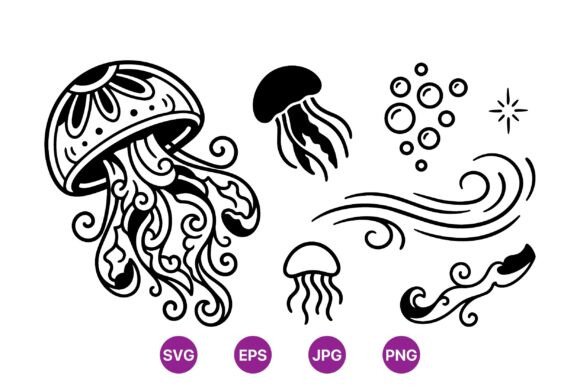
When I opened Decorative Jellyfish Vector Art, my immediate reaction wasn’t “cute ocean clipart”—it was “this has presence.” The ornamental black and white vector art carries a strong sense of rhythm: swirling tentacles curl with deliberate grace, bubbles float like suspended breath, and wave motifs echo in subtle repetition. It’s not literal or scientific—it’s decorative storytelling. This is the kind of graphic design asset that leans into elegance over explanation, making it ideal for a handmade business launching a coastal apothecary line, a boutique print shop curating seasonal stationery, or a wellness brand building a serene marine-inspired identity.
Where It Shines in Real Client Projects
In my recent work for a small-batch candle brand named *Tide & Tallow*, we needed visual texture that felt organic yet refined—no cartoonish sea creatures, no stocky SVG icons. Decorative Jellyfish Vector Art became the quiet anchor of their packaging design: scaled large behind hand-poured soy wax labels, used as a watermark on tissue paper, and repeated at varying opacities across Instagram posts and Canva templates. Its intricate linework held up beautifully on matte kraft boxes and translated seamlessly into sublimation design for ceramic mugs and tote bags.
It performs exceptionally well in these contexts:
- Product mockups—especially for print-on-demand and Etsy product listings where mood matters more than literal accuracy
- Hero graphics for websites or email headers seeking atmospheric calm and visual cohesion
- Printable designs like wall art, greeting cards, or planner stickers (Cricut project files imported cleanly)
- Themed collections—think summer launch campaigns, ocean conservation awareness, or spa retreat branding
- Supporting brand elements—as a pattern repeat, border motif, or background layer beneath clean typography
Where to Use It With Intention—Not Assumption
This isn’t a universal drop-in asset. Its ornamental density means it needs breathing room. I’ve seen clients accidentally undermine its impact by shrinking it too far (tentacle detail dissolves at under 1.5 cm width), placing it over busy photos, or pairing it with ultra-minimalist sans serif logos that clash tonally. Avoid using Decorative Jellyfish Vector Art in:
- Small-scale applications like app icons or favicon-sized assets
- Crowded layouts where visual hierarchy depends on sharp contrast and clarity
- Professional corporate materials—law firms, fintech dashboards, or medical branding—where marine whimsy distracts from trust signals
- Low-contrast environments (e.g., light gray on white) without testing first
- Brands built on stark modern design or brutalist aesthetics—its elegance reads as ornate, not austere
Design Judgment: Mood, Trust, and Audience Alignment
What makes this illustration work commercially isn’t just its vector precision—it’s how it shapes perception. In editorial design for a coastal lifestyle blog, it added emotional appeal without sacrificing sophistication. On t-shirt design for a local beach cleanup event, it elevated the message from functional to meaningful. But crucially, it reinforced visual trust: the consistent line weight, balanced negative space, and intentional asymmetry signaled craftsmanship—not clipart.
For small business branding, that nuance matters. A customer scrolling an Instagram feed doesn’t read your mission statement—they absorb mood first. Decorative Jellyfish Vector Art delivers serenity, curiosity, and artisanal care in one frame. That’s why it strengthens brand consistency when used intentionally—not as filler, but as signature texture.
Practical Designer Notes Before You Commit
Before dropping this into a client file, I always run these checks:
- Test in true black and white—no grayscale assumptions. Does the contrast hold on dark backgrounds? Does it vanish on cream paper?
- Preview at actual size on packaging mockups and social media templates—not just in Illustrator artboard view.
- Check file formats: Confirm SVG editability (anchor points clean? grouped logically?), PNG transparency (no stray pixels), and whether layered AI files are included for font + motif separation.
- Font compatibility test: Try pairing with serif (Playfair Display), sans serif (Montserrat), script (Dancing Script), and display fonts (Bebas Neue). It harmonizes best with expressive serifs and soft scripts—not rigid geometrics.
- Verify commercial license—especially for print-on-demand, digital products, and client deliverables. Look for explicit wording covering resale, merchandising, and SaaS integration (e.g., Canva template use).
Final Verdict: A Thoughtful Asset for Intentional Design
Decorative Jellyfish Vector Art isn’t background noise—it’s a considered visual voice. As a graphic design asset, it excels when the goal is evocation over explanation: for creative marketplace sellers building themed bundles, crafters designing Cricut projects with emotional resonance, or marketers crafting campaign visuals that feel tactile and tranquil. It supports printable design, social media graphics, packaging design, and editorial design—but only when matched to the right audience, scale, and context.
If your client project lives in the space between nature and nurture—between oceanic wonder and human intention—this illustration earns its place. Just remember: elegance isn’t loud. It’s deliberate. And this vector art delivers exactly that.